
Meta uses a variety of catalog fields to better understand your products and provide richer product information across Shops and catalog ads.
Product options #
Use your custom Shopify product options as catalog fields in your product feed.
We include options that exist in any of the products featured in the feed. When generating the feed, we identify all product options for each product. These options are then displayed on the app Settings page, where you can map each option to a corresponding field in the Meta product catalog.

Metafields #
You can map existing metafields or create new ones:
-
Existing metafields: If you already have product or variant metafields, you can map them to the appropriate catalog fields in your product feed. Flexify uses the metafield value for the catalog field you select.

-
Create new metafields for catalog attributes:
- Start by creating a metafield on your Shopify product pages. Choose any namespace you prefer.
- Add a definition and provide values for the metafield.
- Map the metafield to a Meta catalog field.
-
You can then bulk edit these fields in Shopify:
- Navigate to your Shopify Products page and click Bulk edit.
- Adjust and edit the columns as needed.


Shopify category metafield mapping priority #
When a Shopify category metafield and a user-defined mapping rule provide a value for the same feed attribute, the user-defined mapping rule takes priority by default.
Under Settings → Catalog fields → Category Metafields, you can instead give category metafields priority.
When category metafields have priority, Flexify uses the category metafield value when available. The user-defined mapping rule is used as a fallback when no applicable category metafield value is available.

💡 Want to combine your metafield content with existing Shopify data (e.g. keep your original product photos or videos and add new ones via metafields)?
Learn how to merge metafields with Shopify data in your Meta feed.
Tags #
Utilize Shopify tags to add catalog fields to your product feed. Tags should be formatted as 'color:red', 'gender-male' or 'age_group=adult'.
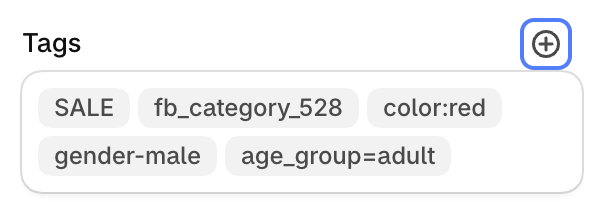

How metafields and tags appear in the feed #
Mapped metafields and Shopify tags are translated into feed attributes. For example:
metafields['flexify']['farbe']='green' ➡️ <g:color><![CDATA[ green ]]></g:color>
product.tags="farbe=green" ➡️ <g:color><![CDATA[ green ]]></g:color>
These mapping options give you more control over the product information Flexify includes in your Meta feed.
Internal Labels via Metafields (Paid Feature) #
You can also use Shopify metafields to populate the internal_label attribute in your Flexify feed. This is useful for organizing products into groups - for example, to mirror your Shopify collections in Meta.
We support both “Single line text” and “Single line text (List)” metafield definitions for this purpose.
On paid plans, values from your metafields will be added to your internal labels alongside product tags and/or collections. This gives you greater flexibility when filtering or grouping products.
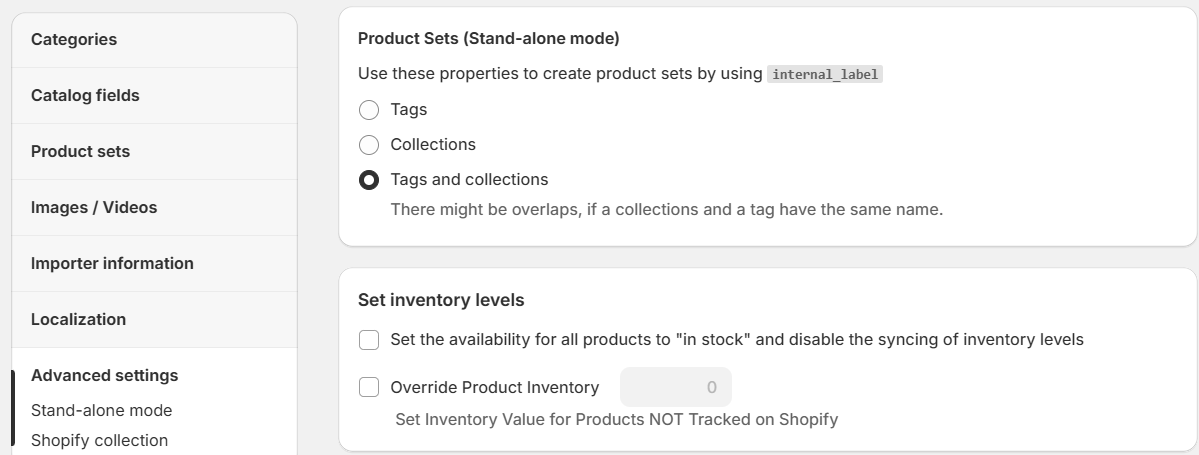
⚠️ Note: Internal labels are supported only in our Stand-alone feeds used in custom-made Facebook catalogs. Supplementary feeds (required for catalogs created by the Facebook & Instagram app sales channel) do not support this attribute.
Use Internal Labels in Meta Product Sets #
You can use internal labels to match your Shopify collections, so it’s easy to create the same product groups in Meta - great for setting up targeted ads or organizing your catalog.